
Anzeige
Fauna Marin GmbH Mrutzek Meeresaquaristik ICP BAS Fauna Marin GmbH

Goniastrea ramosa Lesser star coral

Goniastrea ramosa is commonly referred to as Lesser star coral. Difficulty in the aquarium: Middels. A aquarium size of at least 200 Liter is recommended. Toxicity: Toxic hazard unknown.


Profilbild Urheber Dr. John Edward Norwood "Charlie" Veron, Australien

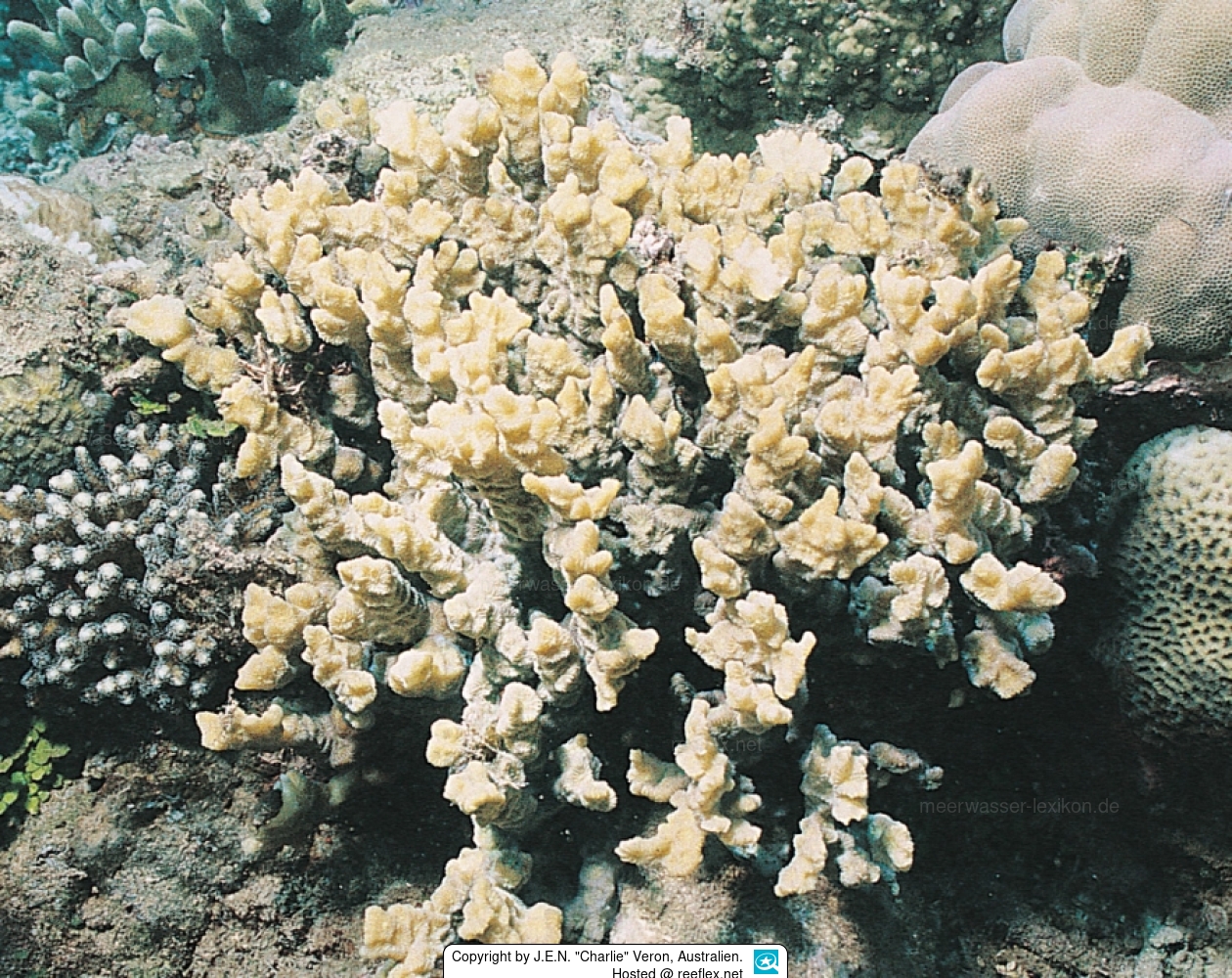
Goniastrea ramosa. Indonesia. A small colony on a sheltered reef flat. Photograph: Charlie Veron.


Courtesy of the author Dr. John Edward Norwood "Charlie" Veron, Australien . Please visit www.coralsoftheworld.org for more information.

Uploaded by robertbaur.

Image detail


Profile

lexID:
1259 
AphiaID:
288028 
Scientific:
Goniastrea ramosa 
German:
Großpolypige Steinkoralle 
English:
Lesser Star Coral 
Category:
LPS 
Family tree:
Animalia (Kingdom) > Cnidaria (Phylum) > Anthozoa (Class) > Scleractinia (Order) > Merulinidae (Family) > Goniastrea (Genus) > ramosa (Species) 
Initial determination:
Veron, 2000 
Occurrence:
Australia, Brunei Darussalam, Fiji, Indonesia, Malaysia, Papua New Guinea, Philippines, Singapore, Solomon Islands, Timor 
Marine Zone:
Subtidal, sublittoral, infralittoral, deep zone of the oceans from the lower limit of the intertidal zone (intertidal) to the shelf edge at about 200 m water depth. neritic. 
Sea depth:
0 - 40 Meter 
Size:
up to 9.84" (25 cm) 
Temperature:
82.4 °F - 84.2 °F (28°C - 29°C) 
Food:
Plankton, Zooxanthellae / Light 
Tank:
44 gal (~ 200L)  
Difficulty:
Middels 
Offspring:
Possible to breed 
Toxicity:
Toxic hazard unknown 
CITES:
Appendix II ((commercial trade possible after a safety assessment by the exporting country)) 
Red List:
Least concern (LC)  
Related species at
Catalog of Life
:
 
More related species
in this lexicon
:
 
Author:
Publisher:
Meerwasser-Lexikon.de
Created:
Last edit:
2026-03-28 19:40:15 

Captive breeding / propagation

The offspring of Goniastrea ramosa are possible. Unfortunately, the number of offspring is not large enough to cover the demand of the trade. If you are interested in Goniastrea ramosa, please ask your dealer for offspring. If you already own Goniastrea ramosa, try breeding yourself. This will help to improve the availability of offspring in the trade and to conserve natural stocks.

Info

“From Veron, J.E.N. Corals of the World.”

Goniastrea ramosa
Veron, 2000

Characters: Colonies are small irregular clumps of branches, usually less than 0.3 metres across. Corallites are angular, with thick rounded walls. The ends of branches are ragged, being primarily composed of exsert costae. Septa are in two alternating orders and have large dentations. Columellae are small and compact. Paliform lobes form a distinct crown.

Colour: Uniform cream or brown.

Habitat: Reef flats sheltered from strong wave action.

Abundance: Rare.

Similar species: Australogyra zelli , Goniastrea retiformis

Source reference: Veron (2000). Taxonomic reference: Veron (2002).

External links

  1. Corals of the World (en). Abgerufen am 07.08.2020.
  2. IUCN Red List of Threatened Species (multi). Abgerufen am 28.03.2026.

Pictures

Commonly

Goniastrea ramosa. Indonesia. A small colony on a sheltered reef flat. Photograph: Charlie Veron.
1

Husbandry know-how of owners

0 husbandary tips from our users available
Show all and discuss