


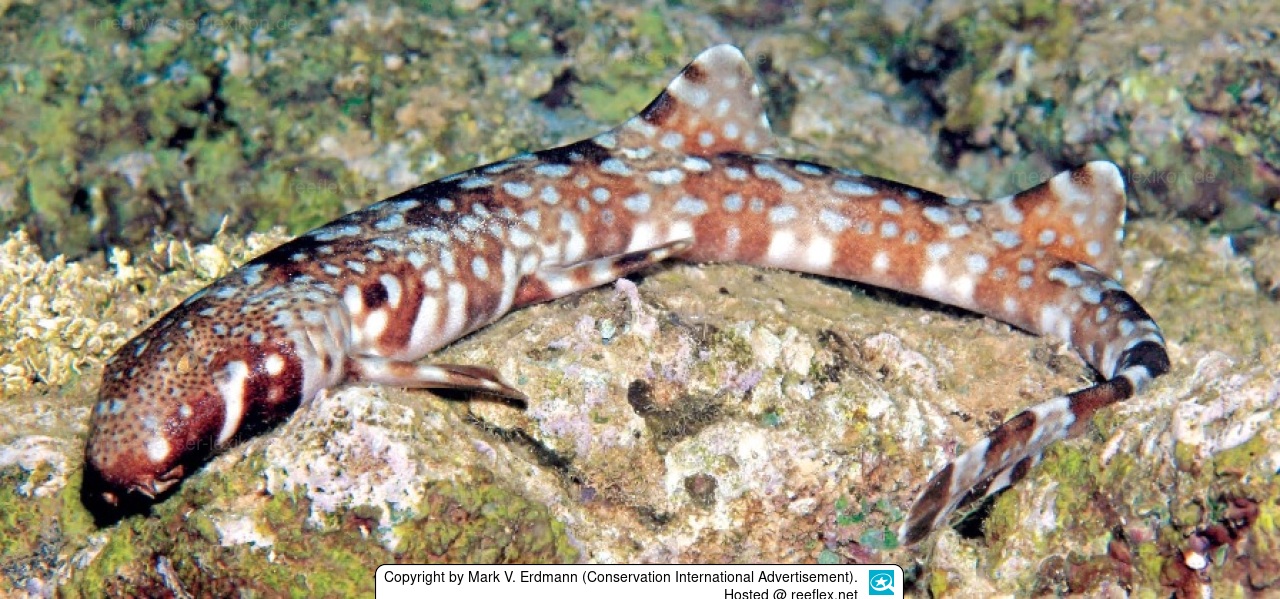
 Dr. Mark V. Erdmann (Conservation International Advertisement), Indonesien


Info
In 2008, two of the leading fish scientists of the 20th century, Dr. Gerry Allen and Dr. Mark Erdmann, published a comprehensive revision of epaulette sharks, also known as bamboo sharks.
We have included the original link below.
The following species of the genus Hemiscyllium are currently known and scientifically described:
Hemiscyllium freycineti (Quoy & Gaimard, 1824)
Hemiscyllium galei (Allen & Erdmann, 2008)
Hemiscyllium hallstromi (Whitley, 1967)
Hemiscyllium halmahera (Allen & Erdmann, 2013)
Hemiscyllium henryi (Allen & Erdmann, 2008)
Hemiscyllium michaeli Allen & Dudgeon, 2010
Hemiscyllium ocellatum (Bonnaterre, 1788)
Hemiscyllium strahani (Whitley, 1967)
Hemiscyllium trispeculare (Richardson, 1843)
Hemiscyllium strahani is a species of Hemiscyllium distinguished by a unique color pattern, especially on the head, from numerous small, dark brown spots on the upper half and widely scattered, larger, dark-edged, roundish to rectangular markings with a pair of broad markings, dark brown to blackish stripes that start on the underside of the snout and cheek and continue on the ventral , separated by a much narrower white band and merging at the throat with an extended dark brown to blackish area that encloses the mouth, chin and tip of the snout; dark cheek bands interrupted by two or more large white spots, and an extended white area (with irregular brown markings) immediately behind the rear dark band.
Color:
Generally reddish-brown to orange-brown with about 7-8 dark brown saddles across the back and dorsal margin of the caudal fin.
Distribution and habitat.
This species is restricted to the north coast of New Guinea, with a known distribution extending from the vicinity of Madang, Papua New Guinea, westward to at least the Jayapura district of Papua Province, Indonesia.
The only record from an intermediate location is an underwater sighting by the first author at Wewak, Papua New Guinea, on Kairiru Island.
It is likely that the distribution extends along the northern coast (Sarmi) of Papua Province westward to the vicinity of Cenderawasih Bay, a stretch of coast that has not yet been surveyed.
In the absence of further information, it is assumed that the Mamberamo estuary may represent a habitat mismatch between the mountain ranges of Hemiscyllium strahani and Hemiscyllium galei.
The preferred habitat of Hemiscyllium strahani consists of shallow seagrass beds near the coast and coral reefs to a depth of at least 20 meters, based on the sighting at Kairiru Island.
The species was named in honor of Ronald Strahan, a former director of the Aquarium at Taronga Zoological Park in Sydney, Australia, and donor of the specimen.
Similarities to other bamboo sharks:
Hemiscyllium strahani is the most distinctive species of all Hemiscyllium species, and is rarely confused with any other species.
The markings on the head are diagnostic and clearly distinguishable from those of Hemiscyllium halmahera, the only other member of the genus with distinct markings on the ventral surface of the head.
However, the morphometric data based on only 3 specimens of Hemiscyllium strahani suggest that the species has a slightly shorter pectoral fin compared to Hemiscyllium galei, Hemiscyllium halmahera and Hemiscyllium henryi.
$sharks
Known species:
Hemiscyllium freycineti (Quoy & Gaimard, 1824)
Hemiscyllium galei (Allen & Erdmann, 2008)
Hemiscyllium hallstromi (Whitley, 1967)
Hemiscyllium halmahera (Allen & Erdmann, 2013)
Hemiscyllium henryi (Allen & Erdmann, 2008)
Hemiscyllium michaeli Allen & Dudgeon, 2010
Hemiscyllium ocellatum (Bonnaterre, 1788)
Hemiscyllium strahani (Whitley, 1967)
Hemiscyllium trispeculare (Richardson, 1843)
Shark bites can be quite lethal to humans, especially the 10 most dangerous shark species are considered and can launch unprovoked attacks from humans: - Great white shark - Bull shark - Tiger shark - Sand tiger shark - Blacktip shark - Bronze shark - Spinner shark - Blue shark - Hammerhead shark - Whitetip shark The bite by a shark is one of the most basic fears of humans, but the number of deaths caused by shark attacks is very low: in 2015 there were 98 attacks by sharks and in 6 cases the attack resulted in a fatal end for humans. In 2016 there were 107 attacks by sharks and in 8 cases the attack resulted in a fatal end for humans. Sources: http://hai.ch/Hai-Infos/Unfaelle/index.html http://www.focus.de/reisen/videos/auch-urlaubsorte-betroffen-schrecklicher-rekord-2016-gab-es-mehr-hai-angriffe-als-je-zuvor_id_6519581.html http://www.spiegel.de/wissenschaft/natur/hai-angriffe-erreichen-2015-rekordhoch-weiterer-anstieg-erwartet-a-1076339.html http://www.zeit.de/2016/37/haie-toetung-tierschutz-surfer
In 2022, there were a total of 108 shark attacks in the USA.
Conversely, however, 100 million sharks were killed by humans. http://www.zeit.de/2016/37/haie-toetung-tierschutz-surfer The risk of being bitten by a shark varies greatly from region to region, with most attacks occurring in Florida, Australia and South Africa. Please be careful not to go into the water with bleeding skin wounds, heed bathing warnings from the authorities and be very careful when using surfboards, as sharks can easily confuse the boards with seals and harbour seals. After shark bites, always call a doctor or / and the rescue service as soon as possible, as heavy bleeding can be life-threatening.
https://worldanimalfoundation.org/advocate/shark-attack-statistics/
We have included the original link below.
The following species of the genus Hemiscyllium are currently known and scientifically described:
Hemiscyllium freycineti (Quoy & Gaimard, 1824)
Hemiscyllium galei (Allen & Erdmann, 2008)
Hemiscyllium hallstromi (Whitley, 1967)
Hemiscyllium halmahera (Allen & Erdmann, 2013)
Hemiscyllium henryi (Allen & Erdmann, 2008)
Hemiscyllium michaeli Allen & Dudgeon, 2010
Hemiscyllium ocellatum (Bonnaterre, 1788)
Hemiscyllium strahani (Whitley, 1967)
Hemiscyllium trispeculare (Richardson, 1843)
Hemiscyllium strahani is a species of Hemiscyllium distinguished by a unique color pattern, especially on the head, from numerous small, dark brown spots on the upper half and widely scattered, larger, dark-edged, roundish to rectangular markings with a pair of broad markings, dark brown to blackish stripes that start on the underside of the snout and cheek and continue on the ventral , separated by a much narrower white band and merging at the throat with an extended dark brown to blackish area that encloses the mouth, chin and tip of the snout; dark cheek bands interrupted by two or more large white spots, and an extended white area (with irregular brown markings) immediately behind the rear dark band.
Color:
Generally reddish-brown to orange-brown with about 7-8 dark brown saddles across the back and dorsal margin of the caudal fin.
Distribution and habitat.
This species is restricted to the north coast of New Guinea, with a known distribution extending from the vicinity of Madang, Papua New Guinea, westward to at least the Jayapura district of Papua Province, Indonesia.
The only record from an intermediate location is an underwater sighting by the first author at Wewak, Papua New Guinea, on Kairiru Island.
It is likely that the distribution extends along the northern coast (Sarmi) of Papua Province westward to the vicinity of Cenderawasih Bay, a stretch of coast that has not yet been surveyed.
In the absence of further information, it is assumed that the Mamberamo estuary may represent a habitat mismatch between the mountain ranges of Hemiscyllium strahani and Hemiscyllium galei.
The preferred habitat of Hemiscyllium strahani consists of shallow seagrass beds near the coast and coral reefs to a depth of at least 20 meters, based on the sighting at Kairiru Island.
The species was named in honor of Ronald Strahan, a former director of the Aquarium at Taronga Zoological Park in Sydney, Australia, and donor of the specimen.
Similarities to other bamboo sharks:
Hemiscyllium strahani is the most distinctive species of all Hemiscyllium species, and is rarely confused with any other species.
The markings on the head are diagnostic and clearly distinguishable from those of Hemiscyllium halmahera, the only other member of the genus with distinct markings on the ventral surface of the head.
However, the morphometric data based on only 3 specimens of Hemiscyllium strahani suggest that the species has a slightly shorter pectoral fin compared to Hemiscyllium galei, Hemiscyllium halmahera and Hemiscyllium henryi.
$sharks
Known species:
Hemiscyllium freycineti (Quoy & Gaimard, 1824)
Hemiscyllium galei (Allen & Erdmann, 2008)
Hemiscyllium hallstromi (Whitley, 1967)
Hemiscyllium halmahera (Allen & Erdmann, 2013)
Hemiscyllium henryi (Allen & Erdmann, 2008)
Hemiscyllium michaeli Allen & Dudgeon, 2010
Hemiscyllium ocellatum (Bonnaterre, 1788)
Hemiscyllium strahani (Whitley, 1967)
Hemiscyllium trispeculare (Richardson, 1843)
Shark bites can be quite lethal to humans, especially the 10 most dangerous shark species are considered and can launch unprovoked attacks from humans: - Great white shark - Bull shark - Tiger shark - Sand tiger shark - Blacktip shark - Bronze shark - Spinner shark - Blue shark - Hammerhead shark - Whitetip shark The bite by a shark is one of the most basic fears of humans, but the number of deaths caused by shark attacks is very low: in 2015 there were 98 attacks by sharks and in 6 cases the attack resulted in a fatal end for humans. In 2016 there were 107 attacks by sharks and in 8 cases the attack resulted in a fatal end for humans. Sources: http://hai.ch/Hai-Infos/Unfaelle/index.html http://www.focus.de/reisen/videos/auch-urlaubsorte-betroffen-schrecklicher-rekord-2016-gab-es-mehr-hai-angriffe-als-je-zuvor_id_6519581.html http://www.spiegel.de/wissenschaft/natur/hai-angriffe-erreichen-2015-rekordhoch-weiterer-anstieg-erwartet-a-1076339.html http://www.zeit.de/2016/37/haie-toetung-tierschutz-surfer
In 2022, there were a total of 108 shark attacks in the USA.
Conversely, however, 100 million sharks were killed by humans. http://www.zeit.de/2016/37/haie-toetung-tierschutz-surfer The risk of being bitten by a shark varies greatly from region to region, with most attacks occurring in Florida, Australia and South Africa. Please be careful not to go into the water with bleeding skin wounds, heed bathing warnings from the authorities and be very careful when using surfboards, as sharks can easily confuse the boards with seals and harbour seals. After shark bites, always call a doctor or / and the rescue service as soon as possible, as heavy bleeding can be life-threatening.
https://worldanimalfoundation.org/advocate/shark-attack-statistics/


