

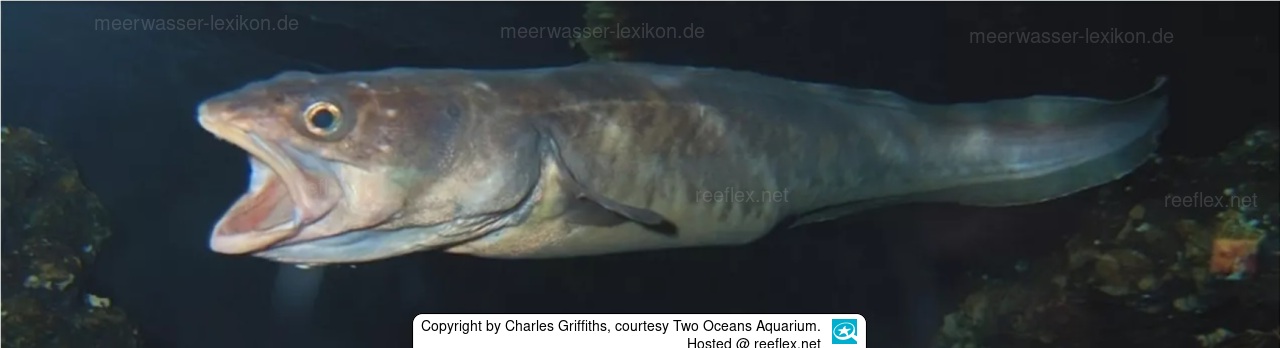
 Dr. Charles Griffiths, Süd.Afrika

Info
Genypterus capensis is a largely unknown and still frequently occurring species, the last fish species from the bearded fish family (Ophidiidae).
The reasons for this are, on the one hand, the rather large depth distribution of the species and the significantly increased demand for the tasty meat, which is also increasingly being offered as a frozen product in Europe.
There are dark fins on the back, the dorsal fin of the kingklip has about 150 fin rays, its anal fin about 100.
The two fins of the benthic male are fused with the caudal fin to form a continuous fin fringe.
On FishBase and in the FAQ there is a note that a distinction between this species and the similar species and Genypterus blacodes is unclear, WoRMS and iEschmeyer's Catalog of Fishes list both species as valid, with Genypterus blacodes occurring circumglobally in the southern hemisphere.
We would like to thank Helen Lockhart and Devon Bowen from Two Oceans Aquarium in Cape Town, South Africa for permission to use the photo by Charles Griffiths.
Synonyms::
Hoplophycis lalandi Kaup, 1858
Xiphiurus capensis Smith, 1847
The reasons for this are, on the one hand, the rather large depth distribution of the species and the significantly increased demand for the tasty meat, which is also increasingly being offered as a frozen product in Europe.
There are dark fins on the back, the dorsal fin of the kingklip has about 150 fin rays, its anal fin about 100.
The two fins of the benthic male are fused with the caudal fin to form a continuous fin fringe.
On FishBase and in the FAQ there is a note that a distinction between this species and the similar species and Genypterus blacodes is unclear, WoRMS and iEschmeyer's Catalog of Fishes list both species as valid, with Genypterus blacodes occurring circumglobally in the southern hemisphere.
We would like to thank Helen Lockhart and Devon Bowen from Two Oceans Aquarium in Cape Town, South Africa for permission to use the photo by Charles Griffiths.
Synonyms::
Hoplophycis lalandi Kaup, 1858
Xiphiurus capensis Smith, 1847

