


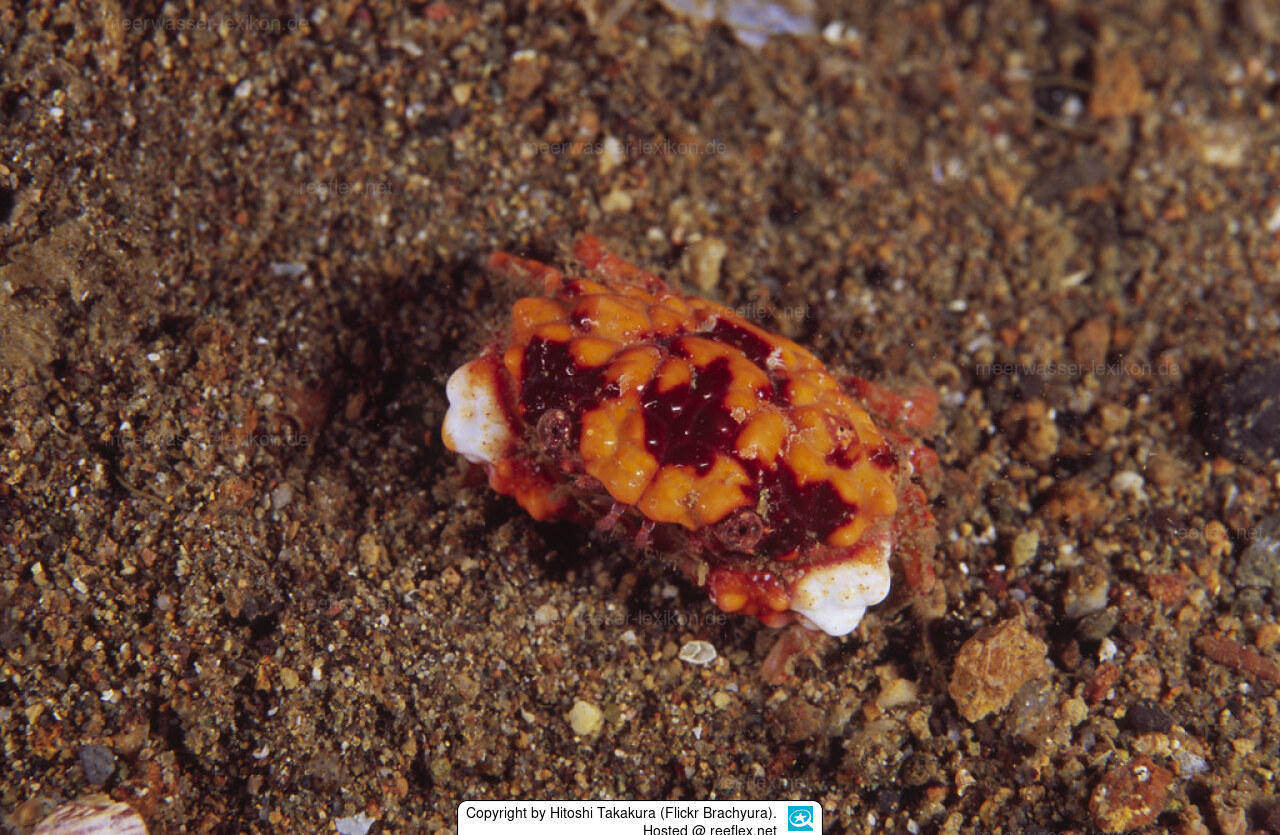
 Hitoshi Takakura (Flickr Brachyura), Japan


Info
Euxanthus ruali Guinot, 1971
Many species of the family Xanthidae can be poisonous, although they themselves have no poisonous apparatus (poisonous teeth, poisonous spines, poisonous glands in the skin), the consumption of these crustaceans can even be fatal for humans. Such animals are considered passive-poisonous.
The toxins of crabs (saxitoxin and tetrodotoxin) are produced by endobacteria and stored in the flesh of the crab, these e are highly potent and similar to the neurotoxins of puffer fish and just as deadly.
In its raw and cooked meat, consumption of the crab meat is toxic to humans!
Please be sure to clarify whether the meat of these crabs is toxic or non-toxic before eating it!
Call an emergency doctor immediately at the first signs of poisoning (e.g. breathing problems, muscle cramps)!
The good news is there’s no way you can be exposed to these toxins if you don’t try to eat these crabs – a bite or a jab isn’t going to do the job.
The bad news for those who unwittingly consume these crabs is that cooking the meat isn’t going to make the toxins any less effective.
Fortunately, toxic crabs don’t want to be eaten just as much as we shouldn’t be eating them, so they help us out with their glorious warning colours.
Synonymised names:
Cancer exsculptus Herbst, 1790
Cancer mamillatus H. Milne Edwards, 1834
Cancer melissa Herbst, 1801
Euryetisus deplanatus Cano, 1889
Euxanthus nitidus Dana, 1852
Euxanthus punctatus A. Milne-Edwards, 1865
Xantho (Euxanthus) nitidus Dana, 1852
Many species of the family Xanthidae can be poisonous, although they themselves have no poisonous apparatus (poisonous teeth, poisonous spines, poisonous glands in the skin), the consumption of these crustaceans can even be fatal for humans. Such animals are considered passive-poisonous.
The toxins of crabs (saxitoxin and tetrodotoxin) are produced by endobacteria and stored in the flesh of the crab, these e are highly potent and similar to the neurotoxins of puffer fish and just as deadly.
In its raw and cooked meat, consumption of the crab meat is toxic to humans!
Please be sure to clarify whether the meat of these crabs is toxic or non-toxic before eating it!
Call an emergency doctor immediately at the first signs of poisoning (e.g. breathing problems, muscle cramps)!
The good news is there’s no way you can be exposed to these toxins if you don’t try to eat these crabs – a bite or a jab isn’t going to do the job.
The bad news for those who unwittingly consume these crabs is that cooking the meat isn’t going to make the toxins any less effective.
Fortunately, toxic crabs don’t want to be eaten just as much as we shouldn’t be eating them, so they help us out with their glorious warning colours.
Synonymised names:
Cancer exsculptus Herbst, 1790
Cancer mamillatus H. Milne Edwards, 1834
Cancer melissa Herbst, 1801
Euryetisus deplanatus Cano, 1889
Euxanthus nitidus Dana, 1852
Euxanthus punctatus A. Milne-Edwards, 1865
Xantho (Euxanthus) nitidus Dana, 1852

