


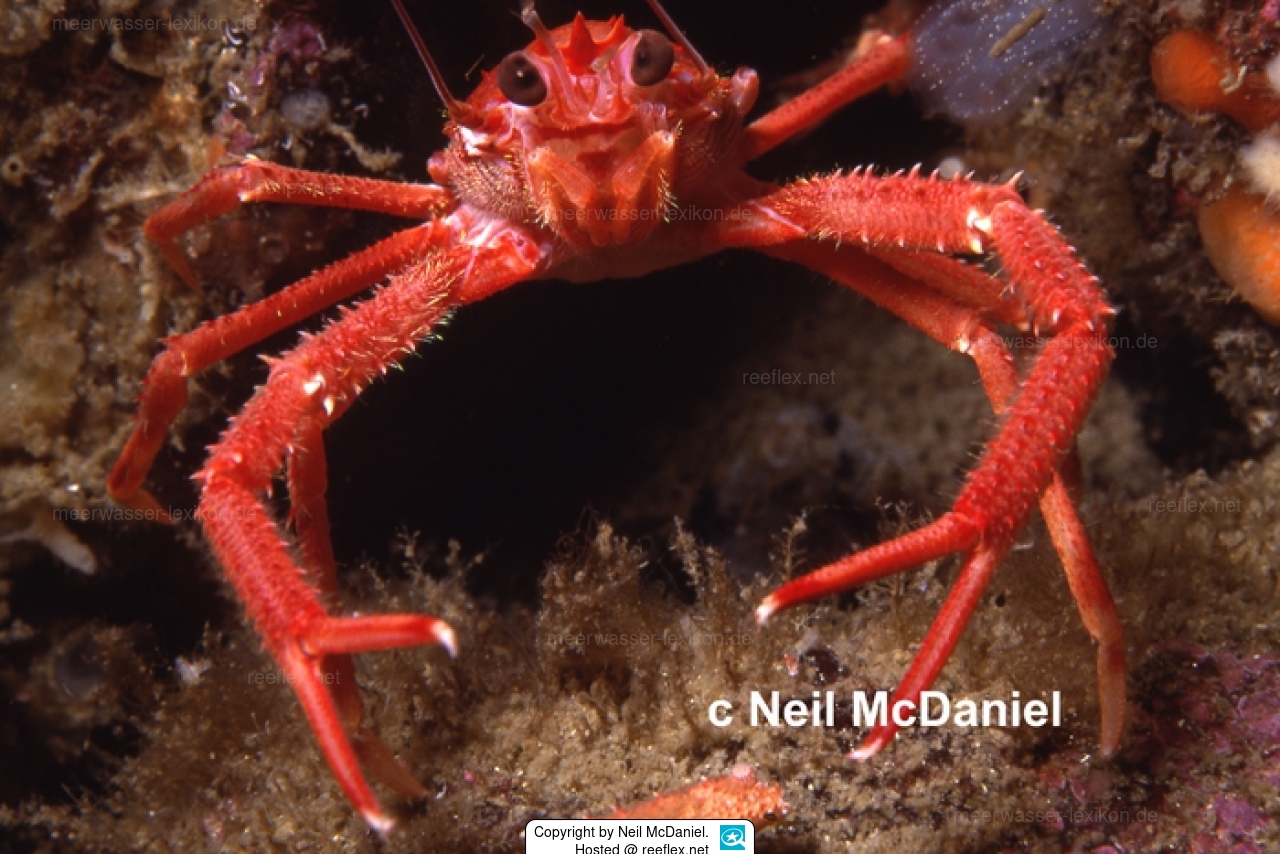
 Neil McDaniel, Kanada


Info
Grimothea quadrispina is a lobster found in colder waters, which sometimes occurs in very large groups in its habitats. A very beautiful photo of such a gathering can be seen here: https://www.inaturalist.org/observations/106142338
The lobster's shell is supposed to protect the animal from potential predators, but Grimothea quadrispina is still a sought-after prey for hake, sharks, mackerel, and seabirds, just as every creature has its place in the food chain.
Grimothea quadrispina feeds on nutrient-rich sediments, small zooplankton, and other benthic crustaceans, but very little information is available about this species.
While adult animals are found along the southwest coast of the US west coast, released planktonic larvae are carried thousands of kilometers out to sea by the California Current, a cold water current.
It has now been scientifically proven that the larvae use a countercurrent at a shallower depth to return to the continental shelf.
Synonym: Munida quadrispina Benedict, 1902 · unaccepted > superseded combination
The lobster's shell is supposed to protect the animal from potential predators, but Grimothea quadrispina is still a sought-after prey for hake, sharks, mackerel, and seabirds, just as every creature has its place in the food chain.
Grimothea quadrispina feeds on nutrient-rich sediments, small zooplankton, and other benthic crustaceans, but very little information is available about this species.
While adult animals are found along the southwest coast of the US west coast, released planktonic larvae are carried thousands of kilometers out to sea by the California Current, a cold water current.
It has now been scientifically proven that the larvae use a countercurrent at a shallower depth to return to the continental shelf.
Synonym: Munida quadrispina Benedict, 1902 · unaccepted > superseded combination


