




 MDPI Open Access Journals

Info
Stragulum bicolor is a crust-forming colony that settles on sandy seabeds as an epibiont on natural substrates, where “natural substrates” refer to numerous basibionts such as mussels, sea squirts, tubeworms, sponges, hydrozoans, gorgonians, bryozoans, and crustaceans.
Recently, there have also been increasing reports of it being found on the support pillars of oil platforms and on shipwrecks.
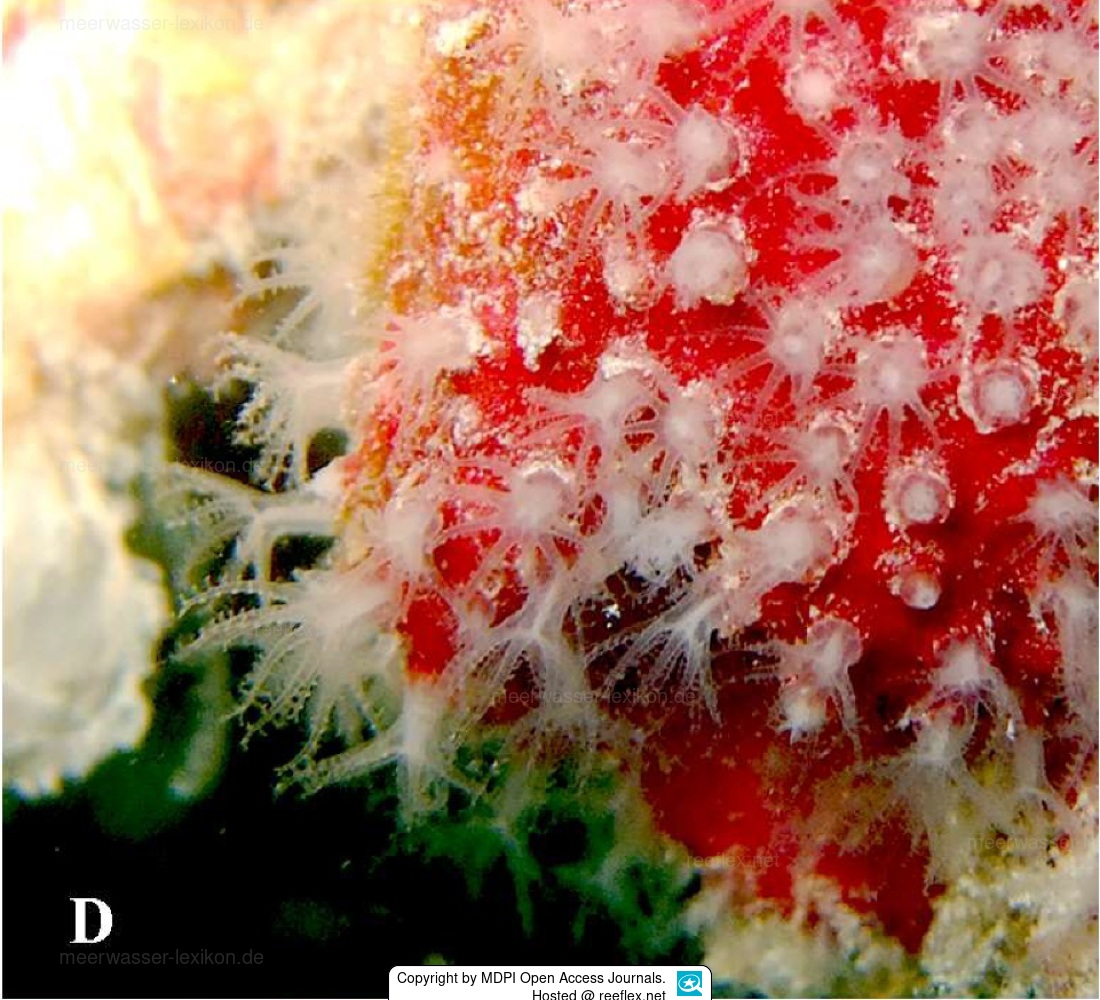
Stragulum bicolor forms warty colonies that are usually reddish and feature large polyps with robust, short, and retractable tentacles on distinctive calyces.
These crust-forming colonies have a warty appearance with a slender coenochyle, the thickness of which rarely exceeds 0.5 mm.
The polyps are housed in white anthocodes, whose diameter varies between 0.4 mm and 2.7 mm; they have short tentacles and can retract into conical calyces up to 5 mm high with their tentacles fully retracted.
The koenochym at the base of the colony exhibits fused sclerites, while the upper layer features rays and cross-connections ranging in length from 0.10 to 0.18 mm.
The sclerites of the anthocodium consist of small scales measuring 0.08–0.12 mm and tentacles with minute spindles.
The inner layer of the koenenchym is colorless; the upper layer is red or reddish.
Samimi-Namin et al. (2022) write:
“Due to the limited number of specimens included in this study, it is still not possible to determine the species’ original range or to establish whether it might be an introduced species.
However, the lack of historical records, its ability to colonize artificial substrates, and a growing number of observations support the invasive nature of the species in Brazilian and Caribbean waters and therefore suggest that it may have been introduced into the Atlantic from elsewhere.”
The snake starfish Ophiothela mirabilis is regularly observed on coral colonies, and it has been found that the nudibranch Marionia limceana feeds exclusively on Stragulum bicolor.
Interestingly, amphidinolides have also been extracted from Stragulum bicolor and its predator; these are a group of more than 30 complex, cytotoxic macrolides derived from marine animals that exhibit potent effects against cancer cells and originate from dinoflagellates of the genus Amphidinium.
Recently, there have also been increasing reports of it being found on the support pillars of oil platforms and on shipwrecks.
Stragulum bicolor forms warty colonies that are usually reddish and feature large polyps with robust, short, and retractable tentacles on distinctive calyces.
These crust-forming colonies have a warty appearance with a slender coenochyle, the thickness of which rarely exceeds 0.5 mm.
The polyps are housed in white anthocodes, whose diameter varies between 0.4 mm and 2.7 mm; they have short tentacles and can retract into conical calyces up to 5 mm high with their tentacles fully retracted.
The koenochym at the base of the colony exhibits fused sclerites, while the upper layer features rays and cross-connections ranging in length from 0.10 to 0.18 mm.
The sclerites of the anthocodium consist of small scales measuring 0.08–0.12 mm and tentacles with minute spindles.
The inner layer of the koenenchym is colorless; the upper layer is red or reddish.
Samimi-Namin et al. (2022) write:
“Due to the limited number of specimens included in this study, it is still not possible to determine the species’ original range or to establish whether it might be an introduced species.
However, the lack of historical records, its ability to colonize artificial substrates, and a growing number of observations support the invasive nature of the species in Brazilian and Caribbean waters and therefore suggest that it may have been introduced into the Atlantic from elsewhere.”
The snake starfish Ophiothela mirabilis is regularly observed on coral colonies, and it has been found that the nudibranch Marionia limceana feeds exclusively on Stragulum bicolor.
Interestingly, amphidinolides have also been extracted from Stragulum bicolor and its predator; these are a group of more than 30 complex, cytotoxic macrolides derived from marine animals that exhibit potent effects against cancer cells and originate from dinoflagellates of the genus Amphidinium.


