


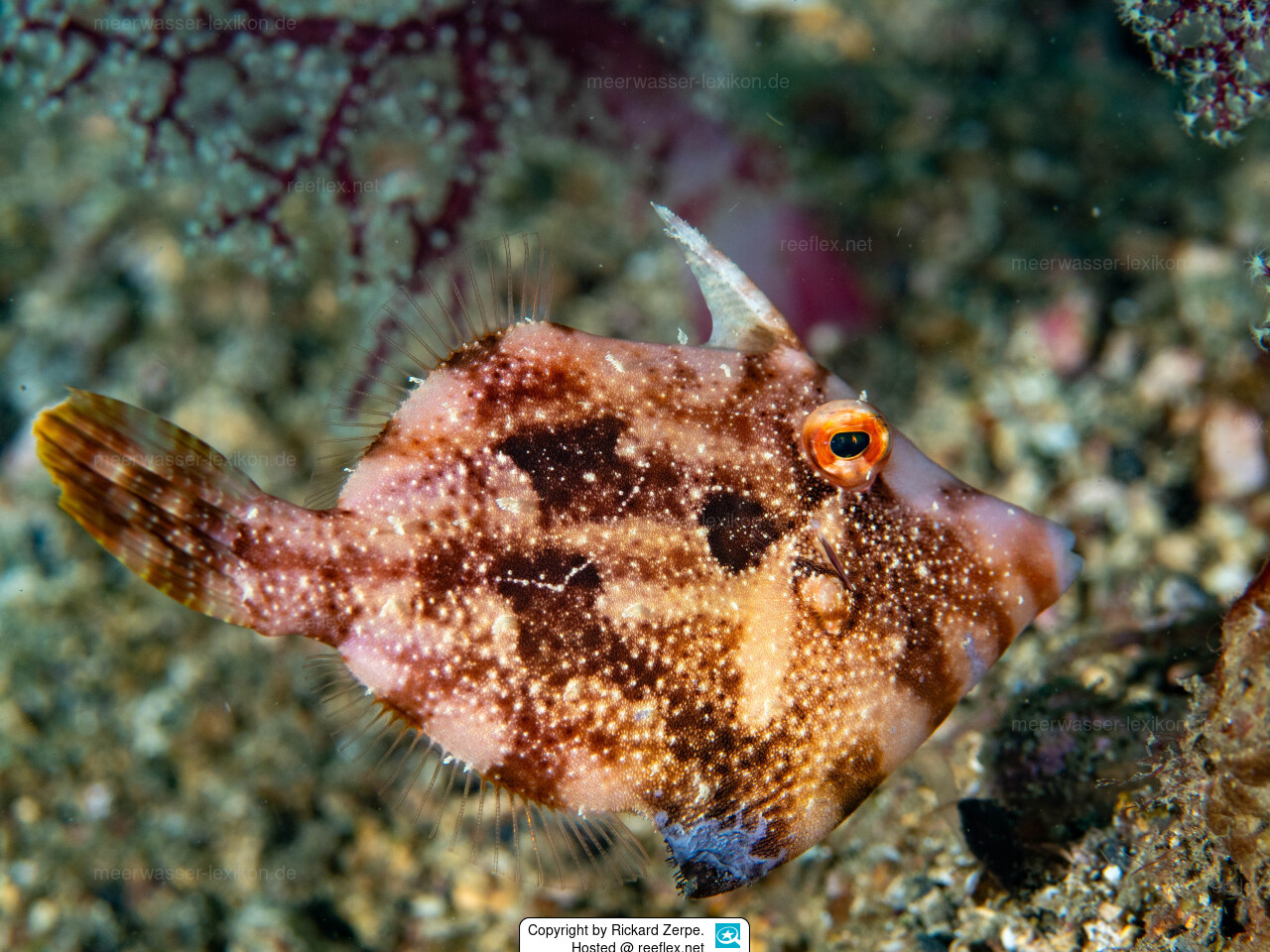
 Rickard Zerpe, Schweden


Info
Paramonacanthus choirocephalus is a benthic marine species found in tropical waters at depths ranging from 3 to 25 meters (Allen and Erdmann 2012).
The filefish is found over sheltered, nearshore reefs and over soft mud and sandy bottoms, usually in small groups (Kuiter and Tonozuka 2001, Allen and Erdmann 2012).
Coloration when fresh (based on color slides of live and freshly caught specimens from Western Australia and Indonesia): Base color is either whitish, pale yellowish, or pale brownish, with dark brown to dark gray spots, which sometimes tend to form two curved, oblique stripes along the body.
The first stripe runs from the rear end of the soft dorsal fin to the pectoral fin; the second runs from the base of the caudal fin to the pelvic fin.
Three dark brown spots are almost always present:
The first below the front half of the soft dorsal fin, extending to the base of the fin rays
The second on the midline of the body, just in front of an imaginary line connecting the attachment points of the soft dorsal and anal fins (always bisected by the obliquely running posterior ventral branch of the lateral line
The third just behind the gill opening near the tip of the pectoral fin.
Additional, less distinct dark spots form bands across the dorsal and ventral sides of the head and body, including 1–2 on the snout, two in the space between the eyes, two in the space between the dorsal fins, one on the posterior half of the base of the soft dorsal fin, one anteriorly on the upper and lower sides of the caudal peduncle, and two above the base of the anal fin.
3–5 such spots are visible on the neck and the front of the pelvic fin (the pelvic fin is sometimes mostly dark).
Thin, dark brown, wavy lines and/or dark spots often run along the head and body; the former are usually clearly visible only in males and form a net-like pattern on the snout and cheeks; a color variant in which most of the dark brown spots are replaced by elongated, irregularly shaped light yellowish-brown spots, giving the appearance of numerous, somewhat longitudinally oriented light yellowish stripes along the sides of the body (the bifurcated dark central spot is always present)
All fin rays are pale yellowish to hyaline; the soft dorsal and anal fins usually have two dark basal spots; the caudal fin features a dark basal spot on the central rays, followed by two broad, curved, dark transverse stripes, with the anterior stripe tapering in the middle in males and usually accompanied by several elongated, blackish spots on the skin, while the rear stripe follows the posterior edge of the fin (sometimes more yellowish than dark)
The central part of the caudal fin in males is occasionally marked with white spots that form two narrow, curved transverse stripes, one on each side of the dark anterior band.
Very little is still known about this species of filefish and its biology.
Colors according to the Atlas of Living Australia: blue, brown, gray, orange, pink, or purple, silver
Synonyms:
Monacanthus choirocephalus Bleeker, 1851 · unaccepted
Monacanthus nemurus Bleeker, 1851 · unaccepted
Paramonacanthus nemurus (Bleeker, 1851) · unaccepted
Paramonacanthus whitleyi Fraser-Brunner, 1941 · unaccepted
Stephanolepis retrospinis Fowler, 1943 · unaccepted
The filefish is found over sheltered, nearshore reefs and over soft mud and sandy bottoms, usually in small groups (Kuiter and Tonozuka 2001, Allen and Erdmann 2012).
Coloration when fresh (based on color slides of live and freshly caught specimens from Western Australia and Indonesia): Base color is either whitish, pale yellowish, or pale brownish, with dark brown to dark gray spots, which sometimes tend to form two curved, oblique stripes along the body.
The first stripe runs from the rear end of the soft dorsal fin to the pectoral fin; the second runs from the base of the caudal fin to the pelvic fin.
Three dark brown spots are almost always present:
The first below the front half of the soft dorsal fin, extending to the base of the fin rays
The second on the midline of the body, just in front of an imaginary line connecting the attachment points of the soft dorsal and anal fins (always bisected by the obliquely running posterior ventral branch of the lateral line
The third just behind the gill opening near the tip of the pectoral fin.
Additional, less distinct dark spots form bands across the dorsal and ventral sides of the head and body, including 1–2 on the snout, two in the space between the eyes, two in the space between the dorsal fins, one on the posterior half of the base of the soft dorsal fin, one anteriorly on the upper and lower sides of the caudal peduncle, and two above the base of the anal fin.
3–5 such spots are visible on the neck and the front of the pelvic fin (the pelvic fin is sometimes mostly dark).
Thin, dark brown, wavy lines and/or dark spots often run along the head and body; the former are usually clearly visible only in males and form a net-like pattern on the snout and cheeks; a color variant in which most of the dark brown spots are replaced by elongated, irregularly shaped light yellowish-brown spots, giving the appearance of numerous, somewhat longitudinally oriented light yellowish stripes along the sides of the body (the bifurcated dark central spot is always present)
All fin rays are pale yellowish to hyaline; the soft dorsal and anal fins usually have two dark basal spots; the caudal fin features a dark basal spot on the central rays, followed by two broad, curved, dark transverse stripes, with the anterior stripe tapering in the middle in males and usually accompanied by several elongated, blackish spots on the skin, while the rear stripe follows the posterior edge of the fin (sometimes more yellowish than dark)
The central part of the caudal fin in males is occasionally marked with white spots that form two narrow, curved transverse stripes, one on each side of the dark anterior band.
Very little is still known about this species of filefish and its biology.
Colors according to the Atlas of Living Australia: blue, brown, gray, orange, pink, or purple, silver
Synonyms:
Monacanthus choirocephalus Bleeker, 1851 · unaccepted
Monacanthus nemurus Bleeker, 1851 · unaccepted
Paramonacanthus nemurus (Bleeker, 1851) · unaccepted
Paramonacanthus whitleyi Fraser-Brunner, 1941 · unaccepted
Stephanolepis retrospinis Fowler, 1943 · unaccepted


