



 Kathleen Boyd


Info
Phyllamphion gundlachi (von Martens, 1878)
The type locality for the description of Phyllamphion gundlachi is Cuba. The type specimen was collected on the Cuban coast near Camaricoia, east of Matanzas. The species name "gundlachi" honours the German zoologist and naturalist Johannes Christoph Gundlach (known in Cuba, where he lived and worked, as Juan Cristóbal Gundlach; 1810–1896). Gundlach spent decades studying the fauna of the Caribbean and Cuba, which is why many species native to the region bear his name.
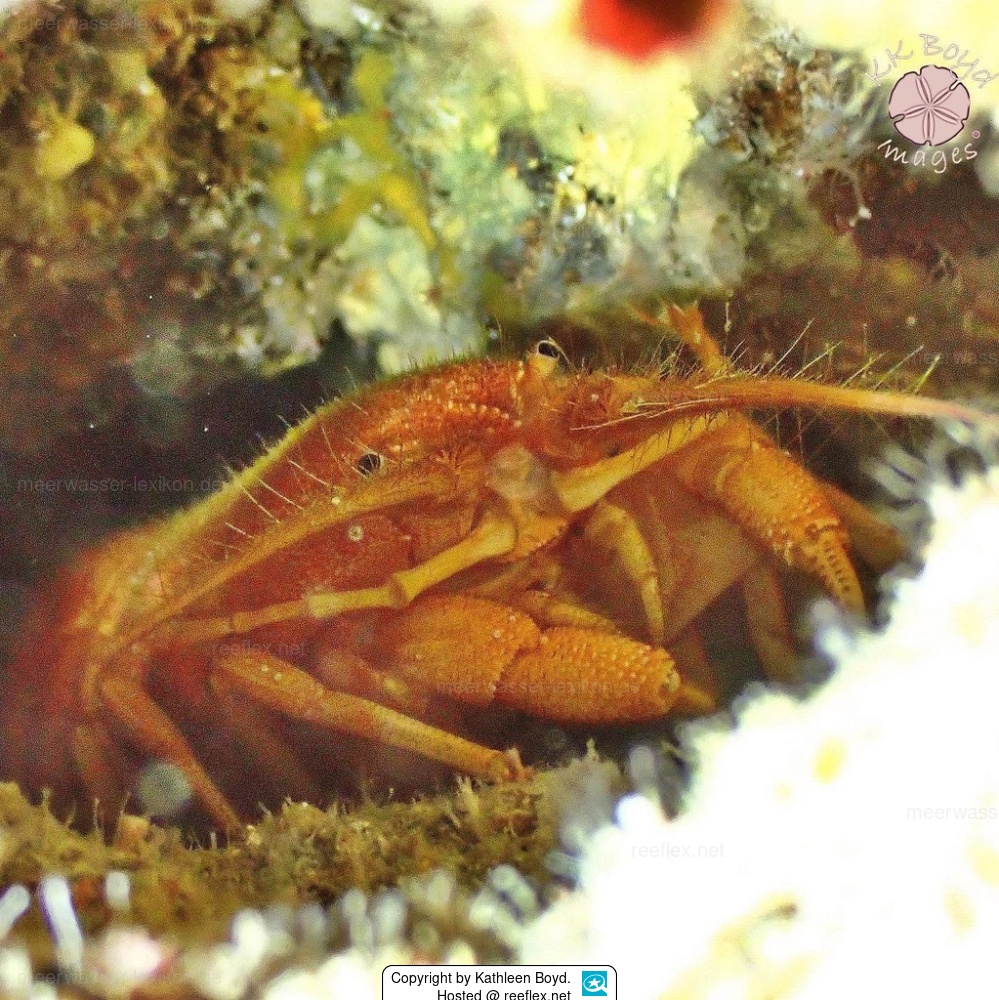
The distinctive feature of Phyllamphion gundlachi is its soft, yellow hairs. These are grouped in tufts of three or four and are distributed over the entire cephalothorax, the antennae, the legs and the upper side of the abdomen.
Furry lobsters (sometimes also called coral lobsters) are small decapod crustaceans closely related to slipper lobsters and spiny lobsters. Their antennae are not as greatly enlarged as those of spiny lobsters and slipper lobsters, and their bodies are covered in short hairs, hence the name "furry lobster".
Although they were formerly regarded as a separate family (Synaxidae Spence Bate, 1881), the furry lobsters were incorporated into the spiny lobster family (Palinuridae) in 1990. Later molecular phylogenetic studies confirmed that the furry lobster genera do not form a natural group, but are each nested among the spiny lobster genera within the family Palinuridae.
According to WoRMS, the genus currently contains only two described species:
Phyllamphion elegans Reinhardt, 1849
Phyllamphion gundlachi (von Martens, 1878)
Synonymised names
Palinurellus gundlachi von Martens, 1878 · unaccepted > superseded combination
Synaxes hybridica Spence Bate, 1881 · unaccepted > junior subjective synonym
The type locality for the description of Phyllamphion gundlachi is Cuba. The type specimen was collected on the Cuban coast near Camaricoia, east of Matanzas. The species name "gundlachi" honours the German zoologist and naturalist Johannes Christoph Gundlach (known in Cuba, where he lived and worked, as Juan Cristóbal Gundlach; 1810–1896). Gundlach spent decades studying the fauna of the Caribbean and Cuba, which is why many species native to the region bear his name.
The distinctive feature of Phyllamphion gundlachi is its soft, yellow hairs. These are grouped in tufts of three or four and are distributed over the entire cephalothorax, the antennae, the legs and the upper side of the abdomen.
Furry lobsters (sometimes also called coral lobsters) are small decapod crustaceans closely related to slipper lobsters and spiny lobsters. Their antennae are not as greatly enlarged as those of spiny lobsters and slipper lobsters, and their bodies are covered in short hairs, hence the name "furry lobster".
Although they were formerly regarded as a separate family (Synaxidae Spence Bate, 1881), the furry lobsters were incorporated into the spiny lobster family (Palinuridae) in 1990. Later molecular phylogenetic studies confirmed that the furry lobster genera do not form a natural group, but are each nested among the spiny lobster genera within the family Palinuridae.
According to WoRMS, the genus currently contains only two described species:
Phyllamphion elegans Reinhardt, 1849
Phyllamphion gundlachi (von Martens, 1878)
Synonymised names
Palinurellus gundlachi von Martens, 1878 · unaccepted > superseded combination
Synaxes hybridica Spence Bate, 1881 · unaccepted > junior subjective synonym


