



 Pauline Walsh Jacobson, USA


Info
Astrogorgia is a coral genus of the Plexauridae family, the species of this genus are found in Southeast Asia and the Indian Ocean.
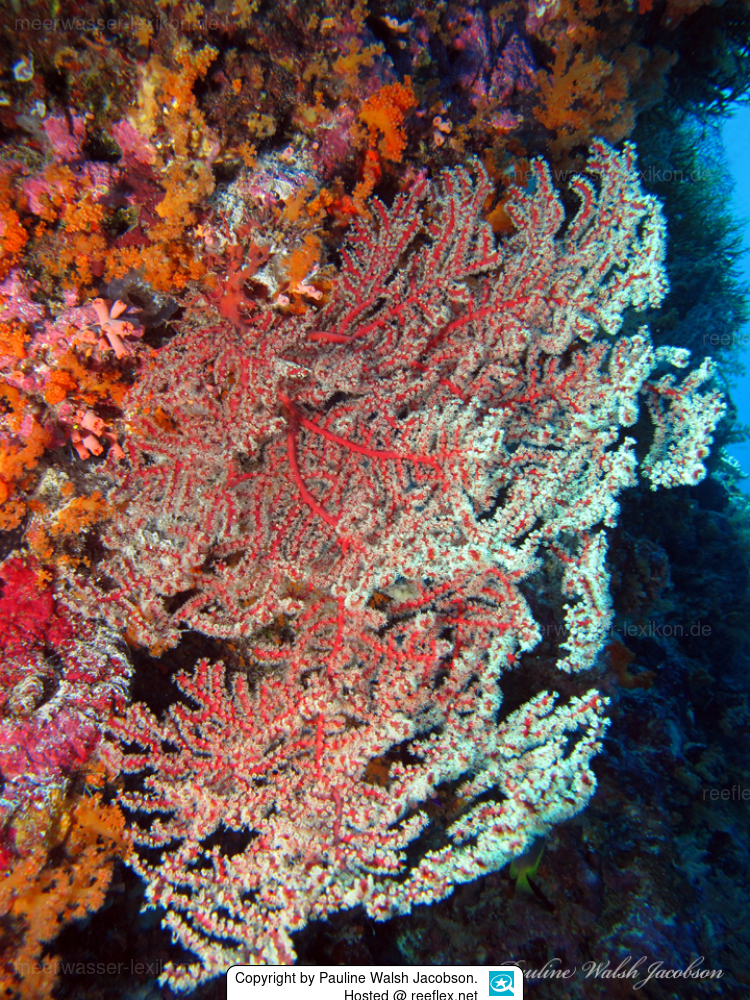
Astrogorgia dumbea forms large, fan-shaped colonies, its new branches are at right angles to the original branches and extend upwards and are laterally flat.
The branches are not exactly in the same plane. The diameter of the stem and the branches is essentially the same, about 0.2 cm,
The polyps are monotypic, distributed around the stem and branches, but with a tendency to concentrate on the sides.
They have a diameter of about 1 mm. The polyps shrink slightly higher than the coral calyx, which is clearly visible and is about 1 mm high.
The tentacles of the gorgonian are provided with numerous small sclerites in oblique double rows.
The color of the coral is a bright red with white tentacles.
The strong color is not caused by zooxanthellae, the coral has none, but by many embedded pigments.
Astrogorgia dumbea prefers to settle on outer reefs with strong currents and deep lagoons, which ensures that the zooplankton rising with the darkness can “reach the polyps of the gorgonian” unhindered.
Etymology:
The species name “dumbea” refers to the location of the coral near Dumbéa, a community in the southern province of New Caledonia.
Astrogorgia dumbea forms large, fan-shaped colonies, its new branches are at right angles to the original branches and extend upwards and are laterally flat.
The branches are not exactly in the same plane. The diameter of the stem and the branches is essentially the same, about 0.2 cm,
The polyps are monotypic, distributed around the stem and branches, but with a tendency to concentrate on the sides.
They have a diameter of about 1 mm. The polyps shrink slightly higher than the coral calyx, which is clearly visible and is about 1 mm high.
The tentacles of the gorgonian are provided with numerous small sclerites in oblique double rows.
The color of the coral is a bright red with white tentacles.
The strong color is not caused by zooxanthellae, the coral has none, but by many embedded pigments.
Astrogorgia dumbea prefers to settle on outer reefs with strong currents and deep lagoons, which ensures that the zooplankton rising with the darkness can “reach the polyps of the gorgonian” unhindered.
Etymology:
The species name “dumbea” refers to the location of the coral near Dumbéa, a community in the southern province of New Caledonia.


