




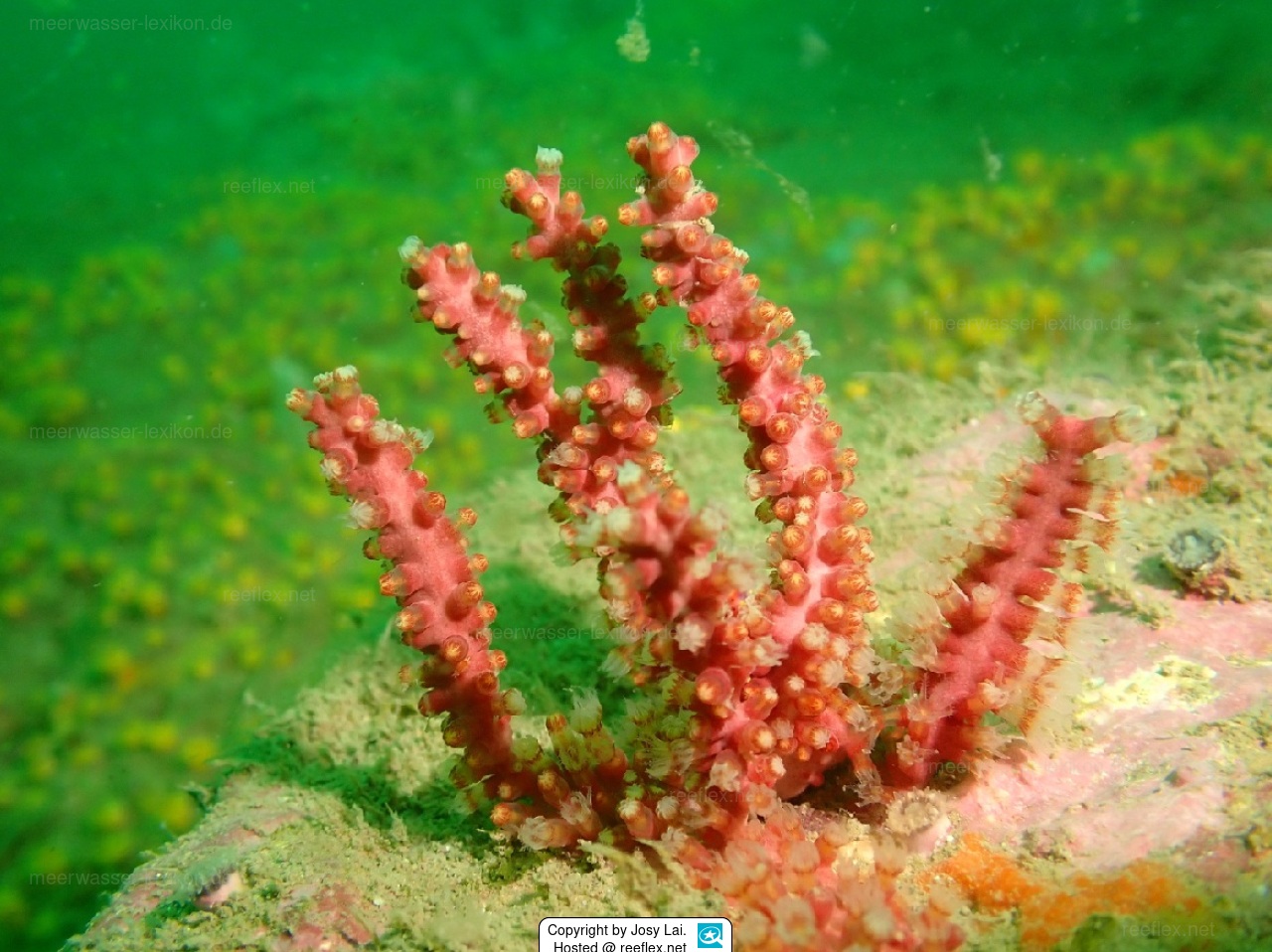
 Josy Lai, Hongkong, China


Info
Unfortunately, no information on the water depth of this species has been recorded, neither in the initial description nor in subsequent publications.
We therefore asked Josy Lai from Hong Kong about her photographs and received the following answer:
“The Astrogorgia sinensi (red color variant) that I saw in Hong Kong usually occurs at depths between 15 and 22 meters.
The dive sites in Hong Kong are generally not deeper than that.”
About the color of the coral
The majority of publications describe the coral as red in color; only “Reef Corals of the Indo-Malayan Seas” mentions other color morphs such as “yellow and orange, etc.”
TaiEOL points out that the color of the colony is deep red or red, with the polyps appearing orange or white.
“A revision of the genus Muricea Lamouroux, 1821 (Anthozoa, Octocorallia) in the eastern Pacific. Part I: Eumuricea Verrill, 1869 revisited” describes the color range of Astrogorgia sinensis as “various shades of red, orange, yellow, white, or yellow-brown.”
Description:
The colonies grow in a plane as open fans with irregular lateral branching (short, lobular branches growing in a plane), never net-like and only rarely interconnected branches.
The branches are usually at a 90° angle to the parent branch.
The main stem and primary branches have a diameter of about 3–4 mm and are slightly flattened laterally.
The polyps are retractable into raised calyxes and arranged in rows or around the branches.
The polyp cells are verruciform, large, irregularly arranged, the surface granular with densely spaced sclerites of 0.5 mm.
The polyps are monotypic, distributed around the branches, but tend to group together on the sides; when they contract, they form conical protrusions on the surface, spaced about 2–3 mm apart.
The sclerites of the polyp tentacles are flattened, spindle-shaped, or small plate-shaped and have sparse conical protrusions on their surface that are about 0.04–0.15 mm long.
The coenenchyme sclerites are mostly spindle-shaped, straight, curved, branched, heavily decorated with complex tubercles and spines, and the inner coenenchyme contains smaller spindles and some capstans.
Anthocodiae with numerous flattened sclerites around the tentacle bases and on the tentacles in numerous oblique rows.
The coenenchyme is hard and leathery on the outside, thick, its surface covered by a thick layer of small, long sclerites of 1 mm.
Etymology:
Latin: meaning “originating from China” or “belonging to China.” It is derived from Sina, the Latin name for China, in conjunction with the ending -ensis, which indicates the origin or location.
Synonyms:
Muricea sinensis Verrill, 1865 · unaccepted > superseded combination (original combination)
Muricella sinensis (Verrill, 1865) · unaccepted > superseded combination
We therefore asked Josy Lai from Hong Kong about her photographs and received the following answer:
“The Astrogorgia sinensi (red color variant) that I saw in Hong Kong usually occurs at depths between 15 and 22 meters.
The dive sites in Hong Kong are generally not deeper than that.”
About the color of the coral
The majority of publications describe the coral as red in color; only “Reef Corals of the Indo-Malayan Seas” mentions other color morphs such as “yellow and orange, etc.”
TaiEOL points out that the color of the colony is deep red or red, with the polyps appearing orange or white.
“A revision of the genus Muricea Lamouroux, 1821 (Anthozoa, Octocorallia) in the eastern Pacific. Part I: Eumuricea Verrill, 1869 revisited” describes the color range of Astrogorgia sinensis as “various shades of red, orange, yellow, white, or yellow-brown.”
Description:
The colonies grow in a plane as open fans with irregular lateral branching (short, lobular branches growing in a plane), never net-like and only rarely interconnected branches.
The branches are usually at a 90° angle to the parent branch.
The main stem and primary branches have a diameter of about 3–4 mm and are slightly flattened laterally.
The polyps are retractable into raised calyxes and arranged in rows or around the branches.
The polyp cells are verruciform, large, irregularly arranged, the surface granular with densely spaced sclerites of 0.5 mm.
The polyps are monotypic, distributed around the branches, but tend to group together on the sides; when they contract, they form conical protrusions on the surface, spaced about 2–3 mm apart.
The sclerites of the polyp tentacles are flattened, spindle-shaped, or small plate-shaped and have sparse conical protrusions on their surface that are about 0.04–0.15 mm long.
The coenenchyme sclerites are mostly spindle-shaped, straight, curved, branched, heavily decorated with complex tubercles and spines, and the inner coenenchyme contains smaller spindles and some capstans.
Anthocodiae with numerous flattened sclerites around the tentacle bases and on the tentacles in numerous oblique rows.
The coenenchyme is hard and leathery on the outside, thick, its surface covered by a thick layer of small, long sclerites of 1 mm.
Etymology:
Latin: meaning “originating from China” or “belonging to China.” It is derived from Sina, the Latin name for China, in conjunction with the ending -ensis, which indicates the origin or location.
Synonyms:
Muricea sinensis Verrill, 1865 · unaccepted > superseded combination (original combination)
Muricella sinensis (Verrill, 1865) · unaccepted > superseded combination


