


 Rafi Amar, Israel


Info
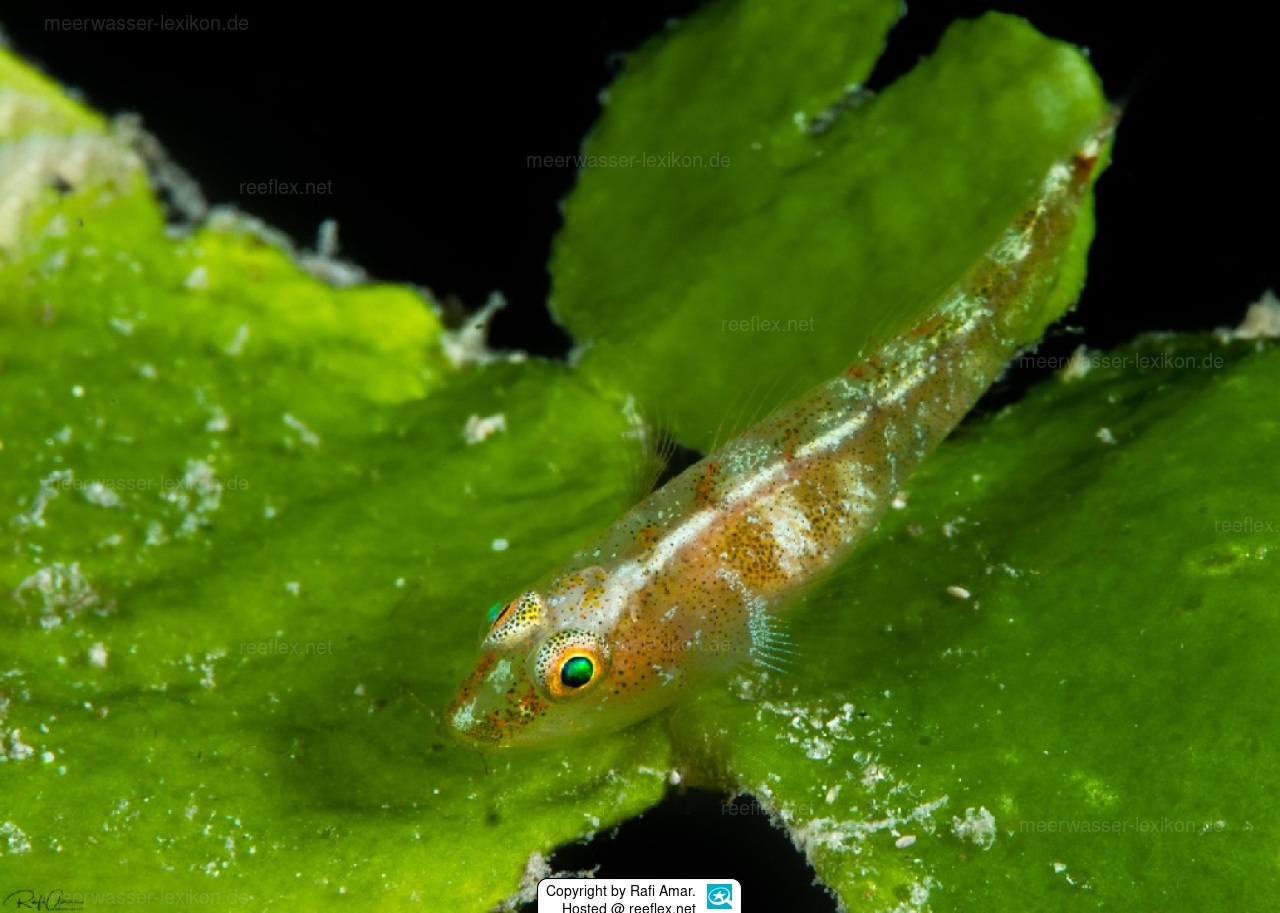
Pleurosicya bilobata is also known as the ghost goby, as it is not easy to spot among the moving seaweed.
It is a translucent green, yellowish-green to brownish goby with about 12 narrow brown to golden-brown stripes across its head and body.
Males have a distinct black spot on the back of their second dorsal fin.
The goby has indistinct, irregular brown stripes on its body, except on its belly and chest, and a brown band on its head that runs from the front of the eye to the upper lip.
The goby's eyes are golden brown with a red ring around the pupil.
Pleurosicya bilobata is a resident of shallow reef flats with algae and seagrass beds, usually on the leaves of broad-leaved seagrasses, such as those of the genus Enhalus and Halophila.
The dwarf goby feeds on small crustaceans on the seagrass blades or in the water column directly surrounding them.
Note:
A distinctly brown specimen can be seen on page 121 of the scientific paper “How many valid Pleurosicya (Teleostei: Gobiidae) species are known from the Red Sea?”
Etymology:
The genus name “Pleurosicya” comes from the Greek, pleura = side, rib + sikya, -os = the feminine form of the word, referring to bottle- or flask-shaped (breast-shaped) gourds, hence sikyos, the masculine form, refers to long-fruited (phallic) gourds or melons.
Refers to the pleural arrangement of the fused, cup-like pelvic fins, i.e., “rib cup”.
Etymology:
The species name “bilobatus” comes from the Latin bi- (= two) and lobata (= lobed) and refers to the two-lobed tip of the tongue of this species.
Synonyms:
Cottogobius bilobatus Koumans, 1941 · unaccepted
Pleurosicya bilobatus (Koumans, 1941) · unaccepted
It is a translucent green, yellowish-green to brownish goby with about 12 narrow brown to golden-brown stripes across its head and body.
Males have a distinct black spot on the back of their second dorsal fin.
The goby has indistinct, irregular brown stripes on its body, except on its belly and chest, and a brown band on its head that runs from the front of the eye to the upper lip.
The goby's eyes are golden brown with a red ring around the pupil.
Pleurosicya bilobata is a resident of shallow reef flats with algae and seagrass beds, usually on the leaves of broad-leaved seagrasses, such as those of the genus Enhalus and Halophila.
The dwarf goby feeds on small crustaceans on the seagrass blades or in the water column directly surrounding them.
Note:
A distinctly brown specimen can be seen on page 121 of the scientific paper “How many valid Pleurosicya (Teleostei: Gobiidae) species are known from the Red Sea?”
Etymology:
The genus name “Pleurosicya” comes from the Greek, pleura = side, rib + sikya, -os = the feminine form of the word, referring to bottle- or flask-shaped (breast-shaped) gourds, hence sikyos, the masculine form, refers to long-fruited (phallic) gourds or melons.
Refers to the pleural arrangement of the fused, cup-like pelvic fins, i.e., “rib cup”.
Etymology:
The species name “bilobatus” comes from the Latin bi- (= two) and lobata (= lobed) and refers to the two-lobed tip of the tongue of this species.
Synonyms:
Cottogobius bilobatus Koumans, 1941 · unaccepted
Pleurosicya bilobatus (Koumans, 1941) · unaccepted

