



 Journal of the Ocean Science Foundation


Info
Ecsenius markalleni was described based on 28 specimens with a standard length (SL) of 19.7–64.7 mm, collected in northwestern Australia, Taiwan, and Japan.
The new coral blenny belongs to the Lineatus group of the genus Ecsenius, which until now comprised only the single species Ecsenius lineatus
The group is characterized by a color pattern consisting of either a continuous, dark, upper mid-lateral band across the upper body—sometimes subdivided into a series of dark segments—that extends onto the head as a dark postorbital band.
The new species has a deeply notched dorsal fin, 16–18 segmented dorsal fin rays, 18–20 segmented anal fin rays, and 34–36 vertebrae.
Ecsenius markalleni differs from its sister species, Ecsenius lineatus, which occurs in the central and southwestern Indian Ocean, in the coloration of both adults and juveniles.
The adult specimen of Ecsenius markalleni can best be distinguished from Ecsenius lineatus by the fact that the dark lateral band is typically unbroken, whereas in Ecsenius lineatus it is divided into distinct segments.
The animals were observed resting on a variety of substrates, including algae, tunicates, sponges, and stony corals. When disturbed, they retreated into abandoned burrows.
Brief description:
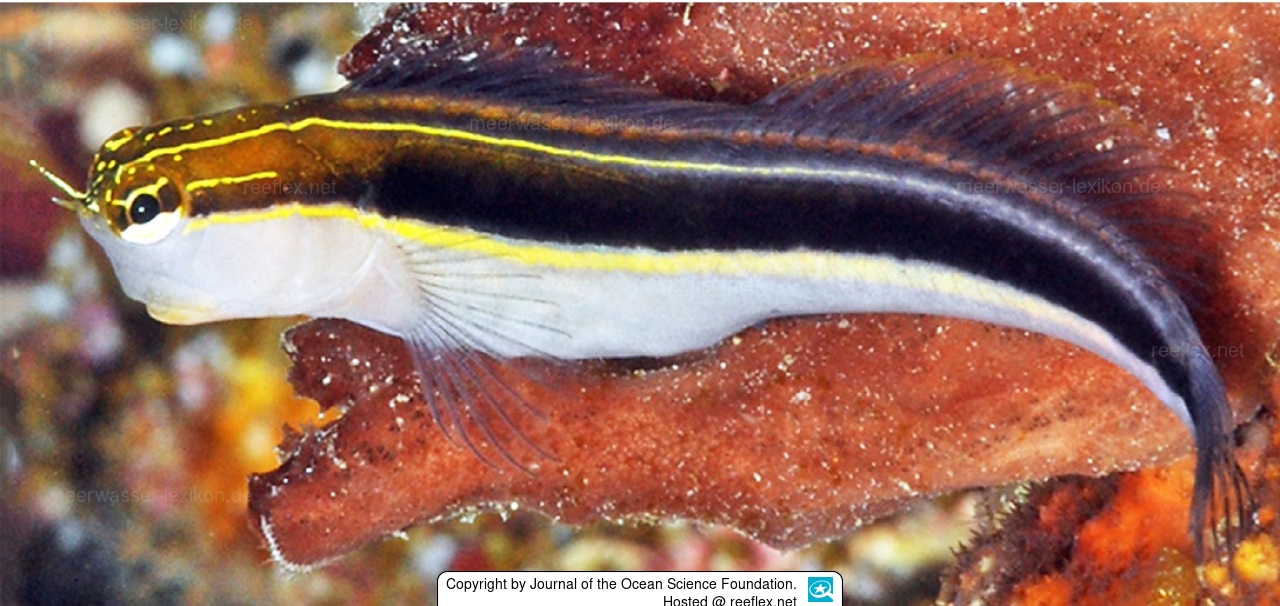
A broad, dark brown to blackish band extends from just behind the eye, across the upper midbody laterally, to the midpoint of the basal caudal fin rays; its width gradually increases toward the midbody, gradually decreases toward the rear, and ends in a pointed extension at the base of the caudal fin.
In some specimens, the band has wavy edges that sometimes merge into contiguous segments (Fig. 2B) or, more rarely, separate segments, particularly in the posterior half of the body;
The body above the dark band is light brown or grayish to dark brown or reddish-brown and divided by a narrow yellow stripe that runs from the upper edge of the eye toward the rear and, at the level of the middle dorsal fin, transitions into a rather grayish or pale stripe that continues to the caudal peduncle.
A second short, narrow yellow stripe immediately behind the center of the eye, adjacent to the upper edge of the postocular section of the dark lateral stripe; occasionally, a diffuse yellowish area also runs along the dorsal edge of the dark stripe on the anterior half of the body.
A third yellow stripe runs directly below the front edge of the dark stripe, extending from behind the eye to the rear of the body, gradually widening and fading in intensity toward the rear;
The rest of the head and body (the lower two-thirds of the head and the lower half of the body) is white, with the exception of the lower jaw, the chin, and the adjacent isthmus, which are yellowish.
The iris of the eye features a dark band that blends seamlessly into the dark lateral band; below the iris band is a whitish or yellowish area, and above the iris band is a narrow yellow stripe that blends seamlessly into the second head stripe.
The fins are mostly translucent with light gray fin rays; the nasal bristles are white.
Freshly collected specimens from Japan resemble the described live coloration but are generally darker, and the lateral band is less contrasting; the narrow yellow stripes bordering the postocular dark band are either completely absent or significantly faded.
Sexual dimorphism.
There are no obvious color differences between males and females, but Springer (1971) discussed several sex-specific morphological characteristics typical of Ecsenius and other blenniid genera.
These include a difference in the urogenital structures, characterized by the fact that the first spine of the anal fin in females is greatly reduced and not visible externally, but is enclosed by a fleshy lobe containing a large urogenital opening and a papilla.
In contrast, in males, both spines of the anal fin are distinctly pronounced, and the urogenital opening is a tiny orifice at the tip of a short, slender tube.
Furthermore, sexually mature males tend to develop thick, fleshy tips on most of the rays of the anal fin—a characteristic absent in females. Finally, in males, the upper and lower lobes of the caudal fin generally become longer with increasing size and maturity.
Etymology.
The new species was named in honor of the first author’s son, Dr. Mark Gregory Allen, in recognition of his invaluable support during numerous expeditions, as well as his tireless enthusiasm and dedication to fish biology and species conservation.
Dr. Mark Gregory Allen was also a co-discoverer of the holotype.
Reference:
Greenfield D.W., Erdmann, M.V. & Liu, S.-Y. V. (2026) Ecsenius markalleni, a new species of coral blenny (Teleostei: Blenniidae) from the eastern Indo-West Pacific Ocean. Journal of the Ocean Science Foundation, 46, 111–128.
https://doi.org/10.5281/zenodo.20766698
Greenfield D.W., Erdmann, M.V. & Liu, S.-Y. V. (2026) Ecsenius markalleni, a new species of coral blenny (Teleostei: Blenniidae) from the eastern Indo-west Pacific Ocean. Journal of the Ocean Science Foundation, 46, 111-128.
https://doi.org/10.5281/zenodo.20766698
The new coral blenny belongs to the Lineatus group of the genus Ecsenius, which until now comprised only the single species Ecsenius lineatus
The group is characterized by a color pattern consisting of either a continuous, dark, upper mid-lateral band across the upper body—sometimes subdivided into a series of dark segments—that extends onto the head as a dark postorbital band.
The new species has a deeply notched dorsal fin, 16–18 segmented dorsal fin rays, 18–20 segmented anal fin rays, and 34–36 vertebrae.
Ecsenius markalleni differs from its sister species, Ecsenius lineatus, which occurs in the central and southwestern Indian Ocean, in the coloration of both adults and juveniles.
The adult specimen of Ecsenius markalleni can best be distinguished from Ecsenius lineatus by the fact that the dark lateral band is typically unbroken, whereas in Ecsenius lineatus it is divided into distinct segments.
The animals were observed resting on a variety of substrates, including algae, tunicates, sponges, and stony corals. When disturbed, they retreated into abandoned burrows.
Brief description:
A broad, dark brown to blackish band extends from just behind the eye, across the upper midbody laterally, to the midpoint of the basal caudal fin rays; its width gradually increases toward the midbody, gradually decreases toward the rear, and ends in a pointed extension at the base of the caudal fin.
In some specimens, the band has wavy edges that sometimes merge into contiguous segments (Fig. 2B) or, more rarely, separate segments, particularly in the posterior half of the body;
The body above the dark band is light brown or grayish to dark brown or reddish-brown and divided by a narrow yellow stripe that runs from the upper edge of the eye toward the rear and, at the level of the middle dorsal fin, transitions into a rather grayish or pale stripe that continues to the caudal peduncle.
A second short, narrow yellow stripe immediately behind the center of the eye, adjacent to the upper edge of the postocular section of the dark lateral stripe; occasionally, a diffuse yellowish area also runs along the dorsal edge of the dark stripe on the anterior half of the body.
A third yellow stripe runs directly below the front edge of the dark stripe, extending from behind the eye to the rear of the body, gradually widening and fading in intensity toward the rear;
The rest of the head and body (the lower two-thirds of the head and the lower half of the body) is white, with the exception of the lower jaw, the chin, and the adjacent isthmus, which are yellowish.
The iris of the eye features a dark band that blends seamlessly into the dark lateral band; below the iris band is a whitish or yellowish area, and above the iris band is a narrow yellow stripe that blends seamlessly into the second head stripe.
The fins are mostly translucent with light gray fin rays; the nasal bristles are white.
Freshly collected specimens from Japan resemble the described live coloration but are generally darker, and the lateral band is less contrasting; the narrow yellow stripes bordering the postocular dark band are either completely absent or significantly faded.
Sexual dimorphism.
There are no obvious color differences between males and females, but Springer (1971) discussed several sex-specific morphological characteristics typical of Ecsenius and other blenniid genera.
These include a difference in the urogenital structures, characterized by the fact that the first spine of the anal fin in females is greatly reduced and not visible externally, but is enclosed by a fleshy lobe containing a large urogenital opening and a papilla.
In contrast, in males, both spines of the anal fin are distinctly pronounced, and the urogenital opening is a tiny orifice at the tip of a short, slender tube.
Furthermore, sexually mature males tend to develop thick, fleshy tips on most of the rays of the anal fin—a characteristic absent in females. Finally, in males, the upper and lower lobes of the caudal fin generally become longer with increasing size and maturity.
Etymology.
The new species was named in honor of the first author’s son, Dr. Mark Gregory Allen, in recognition of his invaluable support during numerous expeditions, as well as his tireless enthusiasm and dedication to fish biology and species conservation.
Dr. Mark Gregory Allen was also a co-discoverer of the holotype.
Reference:
Greenfield D.W., Erdmann, M.V. & Liu, S.-Y. V. (2026) Ecsenius markalleni, a new species of coral blenny (Teleostei: Blenniidae) from the eastern Indo-West Pacific Ocean. Journal of the Ocean Science Foundation, 46, 111–128.
https://doi.org/10.5281/zenodo.20766698
Greenfield D.W., Erdmann, M.V. & Liu, S.-Y. V. (2026) Ecsenius markalleni, a new species of coral blenny (Teleostei: Blenniidae) from the eastern Indo-west Pacific Ocean. Journal of the Ocean Science Foundation, 46, 111-128.
https://doi.org/10.5281/zenodo.20766698


