




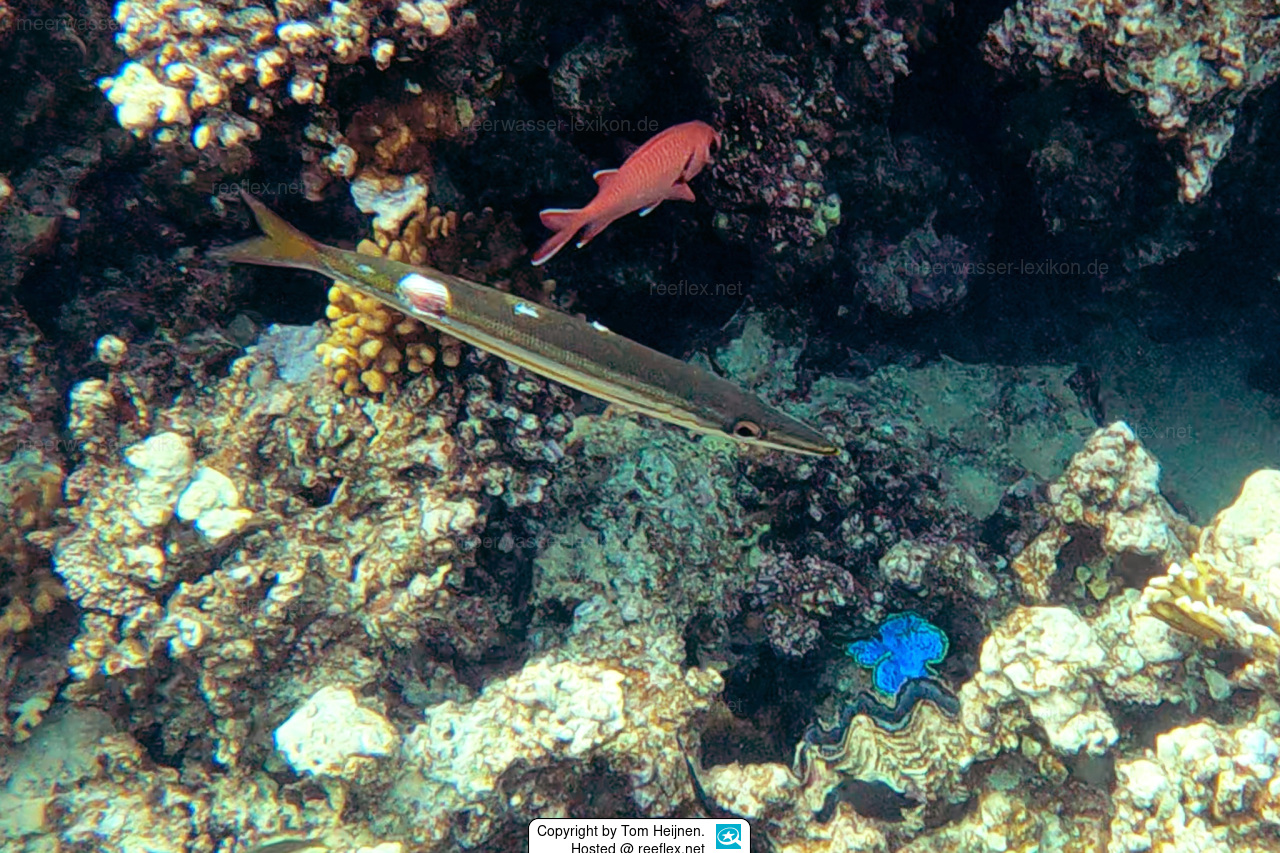
 Tom Heijnen, Niederlande


Info
Sphyraena iburiensis was first described in 2005 off the Pacific coast of southern Japan; subsequent sightings were reported from Taiwan, the Andaman Islands, and even the Red Sea, and it is therefore considered an oceanodromous migratory fish.
With a maximum length of 23 cm, the Iburi barracuda is one of the smallest barracuda species and feeds on invertebrates and small fish found near the surface; however, a detailed list of its prey species is not yet available.
The head and body of Sphyraena iburiensis are greenish-blue on the upper side and silvery-white on the underside.
Two distinct longitudinal stripes are visible on the sides of the body; the upper stripe is brownish-yellow and runs from the dorsal part of the eye, across the front of the lateral line, to the dorsal part of the caudal fin base.
The lower stripe is brown, particularly distinct, and runs from the tip of the snout over the eye and the upper part of the pectoral fin base—2 or 3 scales below the lateral line in the anterior region—and extends to the base of the caudal fin just below the lateral line.
The membrane of the first dorsal fin is completely transparent; the dorsal fin rays are dark.
The membrane of the second dorsal fin is dark at the base and transparent distally; the dorsal fin rays and soft rays are dark.
The anal and pelvic fins are transparent; the pectoral fin is dark, with a dark mark at the base.
The caudal fin is yellow with a continuous dark margin.
Sphyraena iburiensis has a clearly recognizable subterminal mouth.
Synonym:
The species name *iburiensis* is composed of the word “ensis,” a suffix indicating the type locality, and “Iburi” from Kochi Prefecture, Japan.
With a maximum length of 23 cm, the Iburi barracuda is one of the smallest barracuda species and feeds on invertebrates and small fish found near the surface; however, a detailed list of its prey species is not yet available.
The head and body of Sphyraena iburiensis are greenish-blue on the upper side and silvery-white on the underside.
Two distinct longitudinal stripes are visible on the sides of the body; the upper stripe is brownish-yellow and runs from the dorsal part of the eye, across the front of the lateral line, to the dorsal part of the caudal fin base.
The lower stripe is brown, particularly distinct, and runs from the tip of the snout over the eye and the upper part of the pectoral fin base—2 or 3 scales below the lateral line in the anterior region—and extends to the base of the caudal fin just below the lateral line.
The membrane of the first dorsal fin is completely transparent; the dorsal fin rays are dark.
The membrane of the second dorsal fin is dark at the base and transparent distally; the dorsal fin rays and soft rays are dark.
The anal and pelvic fins are transparent; the pectoral fin is dark, with a dark mark at the base.
The caudal fin is yellow with a continuous dark margin.
Sphyraena iburiensis has a clearly recognizable subterminal mouth.
Synonym:
The species name *iburiensis* is composed of the word “ensis,” a suffix indicating the type locality, and “Iburi” from Kochi Prefecture, Japan.

