


 ZooKeys


Info
During a fishing expedition targeting the slimehead Beryx splendens, researchers were pleasantly surprised by the catch, as the net contained colonies of a previously unknown deep-sea gorgonian.
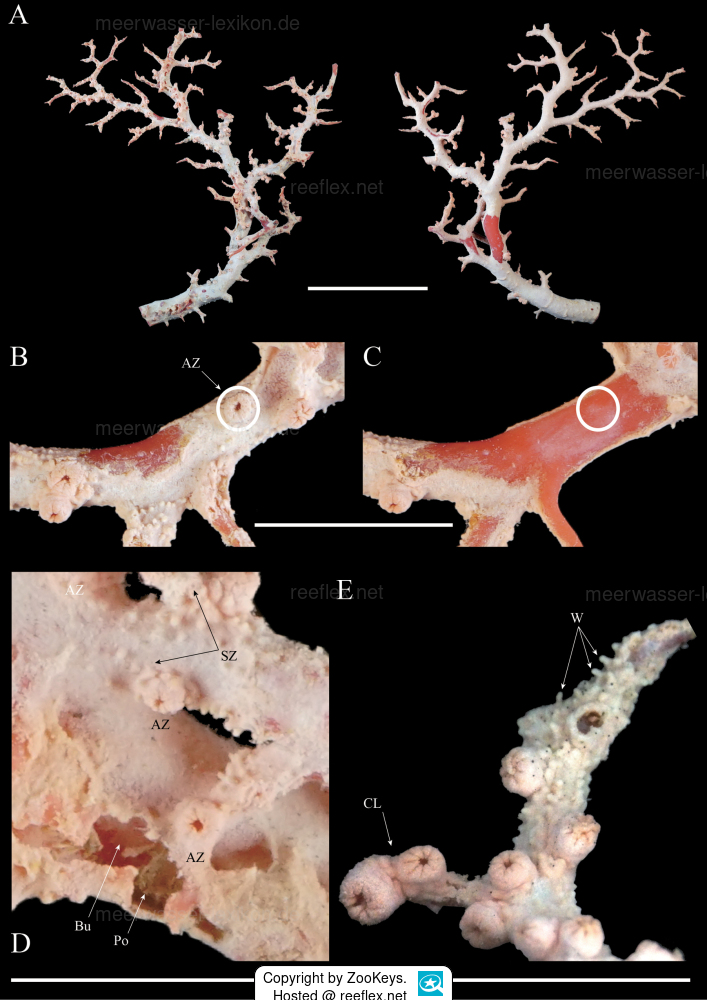
The holotype colony is fan-shaped, approximately 12 cm tall and 13 cm wide.
The colony branches out in a single plane from the main stem; partial fusion can be observed at the break points of the branches, while direct fusion between intact branches is generally absent.
The surface of the coenochym is covered with conical outgrowths that become more pronounced toward the branch tips and form longitudinal grooves when the projections line up.
The colony branches in a single plane, and anastomoses occur only where broken branches come into contact with other branches. The autozooids are contracted but not retracted, and they are distributed on only one side of the colony. There are almost no interstices on the branches, and tufts form at the tips. The axis shows no pits below the autozooids and is pale pink to pink in color. Sclerites are predominantly radiate, and double clubs are rare. Warty rods occur only in the tentacles.
Polyps:
The retracted autozooids are confined to one side of the colony and occasionally form groups of two or three polyps at the branch tips.
On the stem, the autozooids are typically about 4–5 mm apart; however, some are in direct contact with one another, while others are more than 10 mm apart.
They do not retract completely into the coenochym, but contracted autozooids form cylindrical mounds with eight longitudinal stripes connected to the tentacles. D Tiny siphonozooids are present around the autozooids but are barely visible to the naked eye.
Color:
According to the collector, the fresh coenenchyme was orange and showed no color difference from the autozooids.
The dried coenenchyme and the polyps are pale orange; the axis is pink; no color differences were observed between the branch tips, the base, or the interior.
The sclerites are a mixture of colorless and extremely pale orange elements.
Sclerites. The sclerites consist of 6- and 8-rayed elements, double clubs, and rods.
The coenenchymal sclerites consist predominantly of 6- and 8-rayed elements, while rods occur exclusively on the tentacles, where they are predominant.
Double clubs and 7-rayed sclerites are rare throughout the colony.
Variation.
Another specimen (KBF-OA-00437) was attached to a rock.
Similar to the holotype, the colony branches in a single plane, with the contracted autozooids distributed only on one side of the colony.
Many terminal branches are broken off and missing.
The shape, maximum size, and predominant sclerite types in each body part correspond to those of KBF-OA-00436; however, the minimum sclerite size is smaller in KBF-OA-00437.
The axis is slightly paler pink than that of specimen KBF-OA-00436, although it is still darker than the coenenchyme.
Etymology.
The species name “osmanthogemmum” is derived from “Osmanthus” (sweet olive; Oleaceae) and the Latin word “gemma,” meaning “bud.”
This refers to the appearance of large, autozooid mounds grouped at the ends of the branches, resembling the flower buds of Osmanthus.
Reference:
Koido T (2026) A new species of Hemicorallium (Anthozoa, Octocorallia, Coralliidae), along with a revised identification key to species of the genus.
ZooKeys 1277: 339-354. https://doi.org/10.3897/zookeys.1277.184620
The holotype colony is fan-shaped, approximately 12 cm tall and 13 cm wide.
The colony branches out in a single plane from the main stem; partial fusion can be observed at the break points of the branches, while direct fusion between intact branches is generally absent.
The surface of the coenochym is covered with conical outgrowths that become more pronounced toward the branch tips and form longitudinal grooves when the projections line up.
The colony branches in a single plane, and anastomoses occur only where broken branches come into contact with other branches. The autozooids are contracted but not retracted, and they are distributed on only one side of the colony. There are almost no interstices on the branches, and tufts form at the tips. The axis shows no pits below the autozooids and is pale pink to pink in color. Sclerites are predominantly radiate, and double clubs are rare. Warty rods occur only in the tentacles.
Polyps:
The retracted autozooids are confined to one side of the colony and occasionally form groups of two or three polyps at the branch tips.
On the stem, the autozooids are typically about 4–5 mm apart; however, some are in direct contact with one another, while others are more than 10 mm apart.
They do not retract completely into the coenochym, but contracted autozooids form cylindrical mounds with eight longitudinal stripes connected to the tentacles. D Tiny siphonozooids are present around the autozooids but are barely visible to the naked eye.
Color:
According to the collector, the fresh coenenchyme was orange and showed no color difference from the autozooids.
The dried coenenchyme and the polyps are pale orange; the axis is pink; no color differences were observed between the branch tips, the base, or the interior.
The sclerites are a mixture of colorless and extremely pale orange elements.
Sclerites. The sclerites consist of 6- and 8-rayed elements, double clubs, and rods.
The coenenchymal sclerites consist predominantly of 6- and 8-rayed elements, while rods occur exclusively on the tentacles, where they are predominant.
Double clubs and 7-rayed sclerites are rare throughout the colony.
Variation.
Another specimen (KBF-OA-00437) was attached to a rock.
Similar to the holotype, the colony branches in a single plane, with the contracted autozooids distributed only on one side of the colony.
Many terminal branches are broken off and missing.
The shape, maximum size, and predominant sclerite types in each body part correspond to those of KBF-OA-00436; however, the minimum sclerite size is smaller in KBF-OA-00437.
The axis is slightly paler pink than that of specimen KBF-OA-00436, although it is still darker than the coenenchyme.
Etymology.
The species name “osmanthogemmum” is derived from “Osmanthus” (sweet olive; Oleaceae) and the Latin word “gemma,” meaning “bud.”
This refers to the appearance of large, autozooid mounds grouped at the ends of the branches, resembling the flower buds of Osmanthus.
Reference:
Koido T (2026) A new species of Hemicorallium (Anthozoa, Octocorallia, Coralliidae), along with a revised identification key to species of the genus.
ZooKeys 1277: 339-354. https://doi.org/10.3897/zookeys.1277.184620


